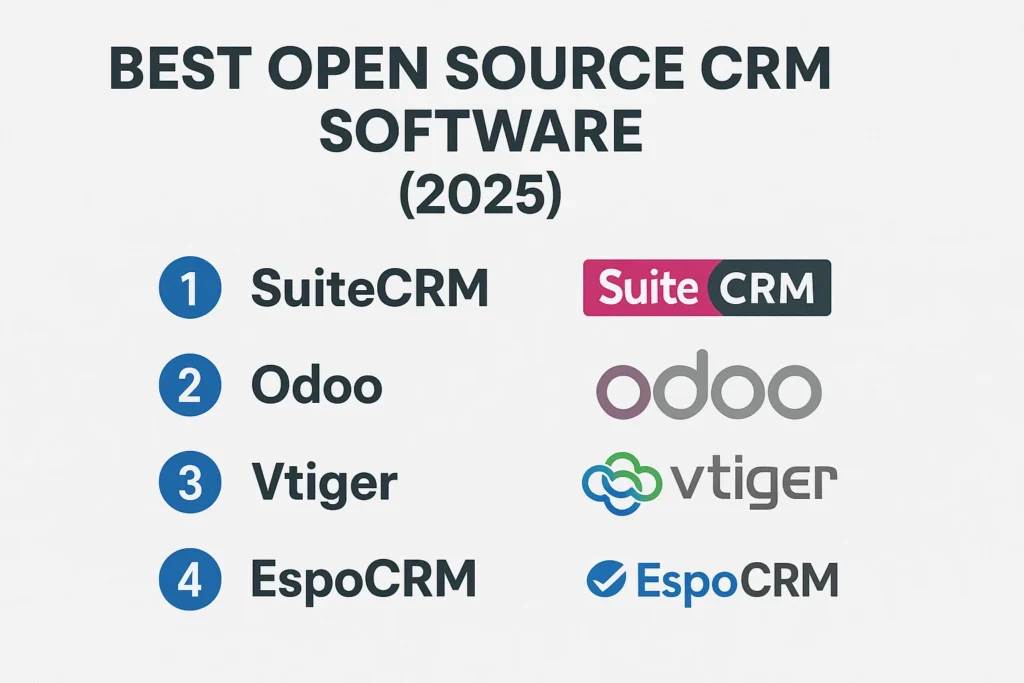
For businesses and developers looking for flexible, cost-effective, and customizable CRM solutions, open-source CRM software offers the perfect balance of control and functionality. Unlike proprietary CRMs, open-source options allow you to fully tailor the platform to your business needs while reducing costs—especially attractive in Tier-1 countries such as the US, UK, Germany, and France, where CRM adoption drives high ROI.
Why Open Source CRM Is Becoming Popular
- Cost-Effective: No licensing fees and lower TCO (Total Cost of Ownership).
- Customizable: Modify workflows, integrations, and UI to suit business processes.
- Self-Hosted Options: Complete control over data and compliance, including GDPR and HIPAA.
- Developer-Friendly: Open APIs, flexible database access, and active community support.
- Integration Capabilities: Connect with marketing, sales, support, and analytics tools.
Top Features to Look for in Open Source CRMs
- Lead and contact management
- Sales pipeline visualization
- Marketing automation
- Custom workflows and fields
- Analytics and reporting dashboards
- Multi-platform access (web, mobile, desktop)
- Security and role-based access controls
Comparison of Best Open Source CRM Software
| CRM Software | Platform | Key Features | Community & Support | Tier-1 Market Popularity |
|---|---|---|---|---|
| SuiteCRM | Web-based | Custom modules, workflow automation, reporting, mobile-friendly | Active community & commercial support | High |
| Odoo CRM | Web & Mobile | Sales pipeline, marketing automation, invoicing, integration with Odoo ERP | Strong developer community | Medium-High |
| EspoCRM | Web-based | Lead tracking, sales automation, API integrations, reporting dashboards | Growing community & paid support | Medium |
| YetiForce | Web-based | Highly customizable, workflow automation, mobile support, security-focused | Active global community | Medium |
Benefits for Tier-1 Countries and High eCPM Markets
Open-source CRMs provide businesses in high eCPM/CPC regions the flexibility to integrate monetizable features like marketing automation, lead scoring, and analytics that directly contribute to higher ROI. Companies can track customer engagement, optimize campaigns, and analyze conversion metrics to maximize profitability.
How to Choose the Right Open Source CRM
1. Assess Your Requirements
Determine which features are essential—lead management, workflow automation, analytics, or integration with existing tools.
2. Check Community & Support
A strong developer community ensures continuous updates, bug fixes, and plugin availability. Paid support options are important for mission-critical operations.
3. Evaluate Customization Capabilities
Open-source CRMs shine in flexibility. Check whether the software allows UI, module, and workflow customization.
4. Consider Hosting Options
Decide between self-hosted for complete control or cloud hosting for ease of maintenance.
5. Security and Compliance
Ensure the CRM supports GDPR, HIPAA, and other local compliance requirements if operating in Tier-1 markets.
Case Studies: Open Source CRM Success
| Company | Industry | CRM Used | Outcome | ROI Improvement |
|---|---|---|---|---|
| Tech Startup USA | Technology | SuiteCRM | Custom workflows, integrated marketing automation | 45% |
| European Consulting Firm | Consulting | Odoo CRM | Unified sales & finance tracking, reduced licensing costs | 38% |
| Retail Chain UK | Retail | EspoCRM | Improved lead conversion, better sales reporting | 42% |
Conclusion
Open-source CRM software offers businesses and developers unmatched flexibility, lower costs, and strong ROI potential—especially in Tier-1 countries. By choosing the right platform, customizing workflows, and integrating with existing tools, organizations can maximize sales efficiency, automate marketing, and gain valuable insights without being locked into expensive proprietary systems.
FAQs
1. What is the best open-source CRM for developers?
SuiteCRM, Odoo CRM, EspoCRM, and YetiForce are top choices for developers looking for flexible and customizable solutions.
2. Can open-source CRMs be used in high eCPM markets?
Yes, they can integrate marketing automation and analytics features to optimize ROI in Tier-1 countries.
3. Are open-source CRMs secure?
Leading open-source CRMs offer role-based access, encryption, and GDPR/HIPAA compliance when properly configured.
4. Do open-source CRMs require coding skills?
Basic usage does not require coding, but customization and advanced integrations may need developer expertise.
5. How do I measure ROI with open-source CRM?
Track metrics such as lead conversion, sales growth, reduced licensing costs, and overall productivity improvements.